Showing posts with label martial arts. Show all posts

Thursday, October 29, 2009

Self Defense Training - 3 Critical Differences Between Martial Arts Training and a Real Attack!

Do you have martial arts experience? Have you taken a self defense training program or two, but know that there is a difference between what you've learned and a real fight?

I understand completely. Because, before I got this area of my life figured out, I was in the exact same place.

When I was a police officer, I and my fellow officers would joke that, when it came to our self-defense training, we were "graduates of Thursday's class at 3 o'clock!" And, police officer or not, we need to know that what we're getting from our self defense training will give us the necessary tools, and maybe more importantly - the confidence - for actually succeeding in a real-life violent attack!

Here's a self defense tip that I used to get what I needed: I looked at what I was learning and compared that with what I actually experienced in a self defense situation against real attackers. Then, and here's what you have to do as well...

I found teachers that could give me what I needed to survive!

But, how do you know if the self defense training you're getting is right?

Here are several differences between conventional martial arts training and most so-called self defense programs. If the self defense training that you're getting overly focuses on these elements... run!

1. Pre-staged training. Technique training is important, but if everything you're doing involves step-by-step, memorized strings of moves with no allowance for variations or drills for creative response and decision-making under pressure, then you are not developing the critical skills you'll need to survive! If you aren't learning to apply the skills your getting in a chaotic, free-response, and stressful way, then what you're doing is really not self defense training!

2. Coddling. While your self defense training should be relatively safe, your instructor should not be coddling you and telling you how great you are. He should also not have to deal with whining, complaining, or other nonsense about you're not wanting to do certain skills for whatever reason. You either want to be able to defend yourself against a brutal attacker who doesn't care about you, or you want to look good and show off!

3. Emotionally-sterile. One of the most important missing elements from most martial arts and self defense training courses is emotion. The reality is that, a self defense situation is a highly-charged - highly emotional experience. It is one of the most emotional situations you could ever find yourself in.

And yet, the majority of time in most training is spent on step-by-step training and theory - not learning how to operate under certain types of psycho-emotional stress - each type limiting your body in very specific ways!

If you really want to survive a real-life attack, then you must find a self defense training program that will give you the tools you will need! You must learn things you never wanted to know, do things most people don't want to have to do, and experience things that will scare you, unnerve you, and make you feel uncomfortable!

But then, you know what your other choice is, right? And he's waiting out there for you!

Is your self defense training giving you the security, skills, and confidence to survive? If you're serious about getting the techniques, tactics and strategies that work, then I want to help you.

Do you want to know how I do it? You can learn more about defending yourself with this strategy and others in this powerful course called, "Foundations of Self-Defense Mastery."

Get this Self Defense Training Course!

This powerful course outlines 6 phases of an effective self defense strategy and training outline that I recommend if you really want to be able to defend yourself against real-world, brutal attackers who want to beat, break or kill you. And the best part is that it's free when you subscribe to my online self defense training newsletter.

And don't forget to get your free self defense DVD: "Danger Prevention Tactics: Protecting Yourself Like A Pro". Click here to get your free self defense training course and self defense DVD and learn how to really protect yourself! http://www.warrior-concepts-online.com

Wednesday, March 04, 2009

Self-Defense Within Martial Arts Training
Demands a Real-World Perspective

This story is being offered in response to a request made by my teacher, Soke (Grand Master) Masaaki Hatsumi, during a recent training visit to Japan. During one of the training sessions, Soke was suggesting that everyone, regardless of rank, should make it a point to talk to those with actual combat experience and to learn from these people. The point was, if you do not know what a real fight is like, you will not be able to train properly for an authentic situation.

I was asked to share some of my experience in dealing with an attack and the following story came to mind. Though I have much experience with dealing with danger and dangerous people, this particular situation stands out as both a successful outcome where I was able to use some of my ninpo-taijutsu martial arts training, and a learning experience where I was actually able to control both my awareness and response, instead of mentally shutting down and "hoping" for the best.

***

The incident occurred many years ago while I was stationed in, what was then, West Germany. I was serving with the United States Army Military Police Corps. My partner and I were called to respond to a unit where a serviceman was assaulting others, including the officer-in-charge.

When we arrived at, what we thought was, the location of the incident, there was no one but the Charge of Quarters present. He had no idea about the incident. What none of us knew was that the 'problem' was occurring next door and moving in our direction.

While my partner and I were confirming the call with our superiors, the attacker entered the building where we were. He was obviously intoxicated and shouting racial insults and demanding satisfaction before he started a 'real war.' By the smell of him, he had been drinking heavily and primarily whiskey. His clothes showed signs of a struggle and at this point I wasn't sure if I was facing an attacker or the victim of an assault.

I immediately tried to calm the individual and find out what the problem was. As I was doing this, several other soldiers, including the command duty officer entered the building and became involved. The belligerent soldier was going on with his racial attacks and how he was attacked by what he thought were his friends. It was then that he turned his attention to me and began implying that he had martial arts experience and "didn't have to prove himself to anyone."

During this, and later after interviewing witnesses, we found that the individual had tested for his black belt in another martial art earlier that day and was out 'celebrating' with his friends. Witnesses testified that the more intoxicated he became, the more he started "showing off" to his friends which involved hitting and kicking. Eventually, his friends had had enough and then attempted to stop his obnoxious behavior by pushing him away and leaving him behind. This only made him more "playful" at which time he jumped on his friends resulting in them throwing him down on the ground. It was this that finally enraged him enough to chase them to the barracks and begin attacking others.

As he was telling me that he didn't have to prove himself, he also made statements that I only thought that I was tougher than him because I carried a gun, a nightstick and wore an MP helmet. I responded by removing my helmet and handing my night stick to my partner in an attempt to neutralize any perceived threat that I might be projecting and bring the soldier's anxiety level down. I informed him that the gun stayed where it was but that we needed to talk like civilized men so we could solve whatever problem was going on.

The soldier continued on with the "I'm a black belt and don't need to prove how tough I am" speech when he closed the distance and, from about an inch from my face, stated that, "I'm going to show you how tough you're not."

I ordered the soldier back and before I knew what was happening, I sensed his fist coming up between our bodies toward my jaw. I rode off the strike which landed before I could evade and then backed out as he began to flail widely with both arms at my head and body. I remember taking up a hoko-like position (a guarding posture in ninjutsu designed to create a protective 'bubble' that is difficult for the attacker to get through) to cover against the incoming attacks and having to simultaneously deal with an officer who thought that I was the one doing the attacking!

At one point, I realized that his right arm had wrapped around my left forearm and that a 'musha-dori-like thing' (uplifting elbow - shoulder dislocating technique) was happening. I remember moving to capture his balance and laid him down when suddenly his feet went out from under him. Later I found out that, in an attempt to help, my partner chose that moment to sweep my assailant's legs out from under him. I felt the soldier's shoulder give way as I applied the lock and took him down. This didn't help with the anxiety and emotional pressure I was dealing with as I was now worried about a possible 'police brutality' charge for excessive force.

This injury didn't deter his aggression though as he continued to fight against our restraint. We were finally able to subdue him and get him onto his stomach to be handcuffed when his wife and young child entered the building. I don't know how they found out about the situation but there they were. I felt sad for them and was only able to give a look of apology for having to do this. Again, more stress was added in that I didn't want to have to physically hurt this man in front of his family.

Unfortunately, their presence only served to escalate the problem. When the soldier became aware of his wife and child, he blamed my partner and I for his "embarrassment" and began to fight against his restraint again. I am not a big man and this soldier's build was easily 150% of my own size and weight, so holding him was a serious problem. Having to improvise and immobilize the man, I placed my night stick between the handcuff chain and his back and applied leverage against his spine which created a situation where he would only hurt himself with his continued resistance. This was only necessary for a moment or two, as he passes out from his exertion.

*************

As I related during my initial telling of the story at the Hombu Dojo ('main training hall'0 in Noda-city, Japan, my legs begin to shake and I can feel my breathing change as I recall this situation and many others like it. It does not control me or the way I go through my life in the ordinary sense that I am not afraid to associate with people or the like. What it has done is imprinted on me much more than just a step-by-step memory of the events, and I'm sure that my recollection of these is less than accurate because the experience was much more emotional and from what Soke has called "budo-nerves" orientation or perspective than from any sort of memorized technique string.

I will simply end this by saying that, this situation is one that has forever changed my perspective on how I should train, and as a teacher, how I should train my students. It has taught me that kata-like, step-by-step training is only a piece of the training puzzle but, anyone who believes that they will fight this way is deluding themselves. Conversely, it has also taught me that training that is just henka-based, where the basics like cover, distance and the like are not drilled until they become second-nature and the student just "does whatever" in an attempt to imitate (his or her teacher) is also deluded. This type of practice is necessary but, again, only a piece.

I am in complete agreement with Soke when he points out that it is the ability to go between the animal instinct response required for surviving an attack and returning to the civilized state to live a happy life, unstained by fear, defensiveness or antisocial behavior because of the attack that should be the goal.

Let me also say that, I respect Soke and the Shihan master instructors that I train with. But, not simply because they are Soke and the Shihan. I respect these people and continue to train in this art precisely because my own experience with having to handle danger tells me that what they have to offer is authentic and "on the mark" with that experience. Because I know that should I ever be attacked again, it will be the lessons that I have learned from them and not my admiration of them or their abilities that will help to insure that my family gets to have me around a little while longer. In a world filled with martial artists and instructors who want trophies, admiration and to 'look good,' it is comforting to know that there are still those who have what the true warrior needs to create a life worth living and the power to protect that life from whatever might harm it.

Jeffrey M. Miller is the founder and master instructor of Warrior Concepts International. A senior teacher in the Japanese warrior art of Ninjutsu - "the art of the Ninja," he specializes in teaching these ancient, proven, and time-tested self-protection and personal development secrets in a way that transforms his students into modern-day Ninja warrior masters themselves.

Want to master the science of self-defense? Get your copy of my free e-book, "Fight Smarter - Not Harder" by going to http://www.warrior-concepts-online.com
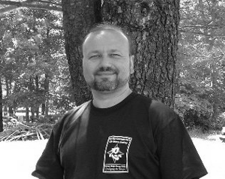
For additional information about how Jeffrey Miller or Warrior Concepts can help you transform yourself with the secrets of the ancient Ninja Warriors, go to the Home page or call WCI at 570-988-2228

This article is copyright (C)2005, 2009 by Jeffrey M. Miller and Warrior Concepts International, Inc. It is free to use in it's original form, with no alterations or additions. If it to be used online, all links must be active and without the use of "no-follow" type coding which would prevent the reader from accessing the resources being referenced.

Get more free articles in Shidoshi Miller's Article Archive!

Wednesday, January 21, 2009

Martial Arts: Are You Learning To Get Your Arms Battered In A Real-World Fight Or Self-Defense Situation?

When it comes to defending targets against an opponent's attacks, especially punching attacks, a martial art student focusing on real-world\effective self-defense must be careful that you're not overlooking one. While this particular target may be virtually invisible to most attackers, not to mention martial arts students and instructors, facing a skilled attacker who knows how to exploit this weakness can have you on the losing end with a broken arm, if not more, when everything is said and doneit's all over.

What is this target?

And how can the bad guy get to this target and you end up with a broken arm, or close to it, as a bare minimum?

Before I answer that question, here's one for you.

Have you ever seen a boxer's stance? Have you ever watched boxers move around during a match?

I'm sure you have.

Now, where are their arms?

Up. Right?

And they do it for cover - to protect their heads and faces from being pummeled by their opponent's fists, right?

Of course.

One more question.

Have you ever seen pictures or film footage of one of the old-style fighters? You know, like Joe Lewis, or even those before his time? Have you ever seen how boxers stood back then, or positioned their arms...before boxing gloves were used?

If you haven't, you really should do some research so you can understand what I'm talking about. Especially if you're serious about being able to survive against an assailant who's serious about beating, breaking, or even killing you.

To get to the point, I'll tell you a little about the old school, bare-knuckle fighters. Even those who used gloves, didn't have the kind of padding that we do today. So, they held their arms and fists in very different positions than today's fighters.

Why?

Because they knew that holding your arms up and out in front of your attacker's fists, would get them beaten. They also knew that if their arms were hit while in this position, that they also stood the chance of punching themselves in the face with their own knuckles!

What does this have to do with you learning self-defense. Simple. Because many teachers are teaching their students to fight or defend themselves with their arms in this modern boxer position.

"So," you might be saying, "what's the problem?"

The problem is that not understanding why something is done, or why it's effective in one context, can lead you to think that it works all the time. And, especially in the realm of self defense and not-dying at the hands of some crazy maniac, this is certainly true.

The reason that modern boxers can hold their arms the way they do is precisely because of their gloves. Sport martial artists fighting in competitions can get away with this also. It's because the opponent's knuckles are covered with padding that protects your arms. So, these fighters never go for the arms as a target. They know that it's pointless.

But, without the gloves, the knuckles can deal a lot of damage to the narrow bones of your forearm. Something that's just not an issue in in a sport fight.

The point here is that, if you're studying martial arts to win trophies or to get belts, do whatever style you want and all the luck to you. However, if you're trying to develop the ability to protect yourself against a brutal assailant who will do anything to brutalize you, there are certain mistakes you can't afford to make.

So, regardless of what you've been taught, avoid holding your arms vertically or at least turned with the broad back of the forearm out and use distance to keep the bad guy from going after your arms. After all, it's going to be very difficult to throw your own punches with arms that have been beaten or even broken because you put them out there for him to beat on.

Are you a private individual, law enforcement or security professional, member of the military, or corporate manager looking for real-world self-defense training that works?

Get the knowledge you need to effectively handle a real world self-defense situation.

Get three self-defense reports when you get my Self-Defense Super Library

Jeffrey Miller is an internationally known self-defense expert. He is the creator of the powerful EDR: Non-Martial Arts Defensive Training System and teaches individuals, security professionals, companies, and organizations how to be more safe in Today's often unsafe world. Go to his web site at => www.warrior-concepts-online.com

Sunday, August 17, 2008

The Unseen Value of Martial Arts Training - A Lesson From Ben Franklin

During one of my recent trips to Japan for training with Bujinkan Grandmaster, Masaaki Hatsumi, one of the themes he touched upon in class was in the value of our training. And, how much like a good investment, the longer we participated, the more value we received.

Ironically, most students who come in to the academy, as with most things in their life, are looking for "quick results." Or, more to the point, a "quick fix." They say they're looking for self-defense and the ability to protect themselves from the ever-growing threat of danger in our world. But, what they're really looking for is a greater feeling of confidence. And, once they start to feel like they can handle themselves, which is usually after learning a couple of techniques well...

...they quit!

Soke ("head-of-lineage") Hatsumi, my teacher and the grand master of the Bujinkan Dojo, reminded us that...

..."there is a huge difference between "feeling" like you can handle yourself, and the ability to actually do it."

He said that most students are not willing to put enough time, effort, or energy to really understand what it feels like to live a life where, not only are they able to deal with danger should it happen to them, but that they don't have to worry about attackers appearing at all!

It's amazing, but true. As I have climbed the ladder in both rank and skill, there is one thing that I've noticed above all else. And that is...

...the greater my skill, the less I've had to use it for self-protection!

As a 12th degree Black Belt, I can't tell you how long it's been since I've had to deal with the threat of someone wanting to do me harm. And this is not limited to a physical assault, but extends into every area of my life.

I can hear many ask, "Why bother training at all, if you never have to use your skills for self-defense anyway?"

"Why bother at all? Why not just take your chances?"

While these questions sound logical, they are asked from the viewpoint of convenience. And, as we all know, what sounds good in theory, is often the furthest thing from reality.


The reason we train is twofold:

First, we train to realize that ideal life where we won't have to worry about danger because, even if it did occur, we knew we could handle it. And,...

Second, we're not there yet and may need to protect ourselves along the way to attaining our goal!

Benjamin Franklin, one of the acknowledged Founding Fathers of this great nation, once said, "They that are on their guard and appear ready to receive their adversaries, are in much less danger of being attacked than the supine, secure and negligent."

The truth is, the longer we train and the better we develop our skills, the safer we will be. This is true both of our self-defense techniques as well as our personal development skills.

In fact, I believe that it is precisely those traits and qualities that the martial arts have helped me to nurture, grow, and develop - traits like confidence, discipline, respect, commitment, and a host of others - that actually act as my shield against most attackers. It is these more than any physical skill that communicates to others that I am a confident, powerful person in control of his world, that determines who will want to connect with me, and for what reason.

Why learn the often-violent methods associated with the martial arts then, if all I had to do was to develop those inner qualities that keep me safe? Again, same reason as I mentioned before...
...until I do, I am at-risk from those forces that would seek to harm me.

Ironic, isn't it?

We come to self-defense training to be ready and able to protect ourselves from harm and, at the same time, are preparing ourselves for a day when few would ever want to. Because it is precisely our ability to handle ourselves, that creates the end result. Not the other way around.

Be careful. Only looking at the obvious parts of training will cause you to miss the big picture and the unseen value that it holds for you, and the rest of your Life!


Get more free articles like this one at www.warrior-concepts-online.com/articles.html

Also...

You can now subscribe to my new podcast radio show called "KUDEN". You can read more about it and the upcoming web-based seminars that I'll be offering by scrolling down a bit to the prior post with that information. Please note that, due to technical difficulties, the release dates had to be changed from what's listed in the original announcement. I just recorded the first show and it goes live on Wednesday, August 20th, 2008!

Other no-cost training resources:

Are you subscribed to my self-defense and ninja training newsletter? If not, you probably haven't received the free gift that you get when you subscribe. What is it?

It's a 7-part ecourse called, Foundations of Self-Defense Mastery" and it's my gift to you for becoming a member of WCI's growing group of online students and teachers. At this point, we have over 6,000 members and growing!

The newsletter itself is a fantastic way to keep informed and add to your knowledge and training database about topics like learning self-defense, online ninja training, women's self-defense, and even tips for parents on child safety. Add to that, this free course and the other books, videos, and live training programs offered through WCI, and you've got a one-stop place for all your self-defense, martial arts, and Ninja Training needs!

Alright. Enough of telling you why you're crazy if you haven't subscribed. Here's the link to get the newsletter and the free ecourse: Learn Self-Defense!


Until next time.

Peace, Happiness, and Success!

Shidoshi Miller

Saturday, June 16, 2007

Aiming for the BEST Targets!


When discussing self-defense for beginners and those new to the realm of self-protection, I'm often asked...

"If I just want to get out of there and need to shut this guy down fast, what are the best areas of his body to hit?"

I love questions like this, because it tells me that the person asking it is thinking "strategically" rather than simply mechanically. If you ask questions, not related as much to "what" it is that you can do but, "how," "where," "when," and "why"...

...it tells me that you're thinking about results, effectiveness, and efficiency...

...all signs of a true martial arts master or self-defense expert.

Well, before answering this all-important question, let me tell you that I'm writing several new books focused on this very important, and often overlooked topic. In fact, the demand for such books is so high, that I just can't get things done fast enough!

The following are just a few of the topics currently on the "get it out there so they can use it" list:

  • Ninja Juroppo-Ken "The 16 Fists of the Ninja"

  • Stop, Drop, & Run! "The Best Targets to Attack for Escaping a Self-Defense Situation Quickly!"

  • Shuriken-Jutsu "The Art of Mastering the Ninja's Throwing Stars"

  • Hanbo-Jutsu "Using Short Sticks and Cans for Self-Defense"


I really DO have quite a list, and it keeps growing every day.

I'll be releasing information about each book or video as it becomes available so be sure to stay informed.

I'm also asking readers to post comments telling me what you'd like to see included in the above books. While you're at it, if there's a topic (book, weapon, etc.) you'd like me to write or produce as a video, tell me that too. (Oh, and for all of the spammers out there, your sales pitch posts will be deleted so... save your time and ours and keep moving!)

Now... where was I? Oh, right... excellent targets.

As I see it, there are seven body targets that are perfect for the beginnner to focus on if they're looking to be able to drop an assailant quickly and effectively. As a quick side-bar, let me also say that there are many ways of attacking each target and selecting the best one in an attack situation will take more than just knowing it's there.

That being said, here are the 'Dirty 7':

  • 1. Nose - Nothing stops an assailant, or anyone else for that matter, like a quick shot to the nose - in ANY direction! Even a light shot instantly brings tears to the eyes and disorientation. And... NO! It's not generally considered a killing shot by 'real' experts!

  • 2. Eyes - Human beings are generally sight-oriented creatures. And, our bodies are hard-wired to protect our eyes from even the slightest danger. Even the mere threat of attacking your opponent's eyes will have him changing his tactics as a minimum, and running for the hills as a best-case scenario!

  • 3. Jaw/Tip of Chin - A well-placed palm-strike to the tip of the chin, or even a thumb-tip driven up under the jaw-line will send an attacker realing in pain or knock him out cold!

  • 4. Throat - Just as with the eyes, our bodies are wired to protect the most vulnerable areas. The windpipe, arteries, and veins that pack the neck and throat area are all life-sustaining systems. And... they are exposed to the world and without their own defenses! A firm grab or sharp blow to any of these systems can shut an attacker down - permanently!

  • 5. Sternum/Solar Plexus - The bottom tip of the sternum, or breat bone, is called the xyphoid process (pronounced "zie-foid"). It's a small, triangular shaped, boney protrusion that actually has some flex to it. It points at the top of the abdominal cavity which, itself, is sensitive. These defensive "alarm" triggers are there to warn the body of attacks to the heart, lungs, and other organs NOT protected by the ribs in this region. Even a light punch or kick to this area can leave the assailant breathless - or worse.

  • 6. Groin - Do I really need to describe the effects of a grab, punch, or kick here? Didn't think so. However, it would be a good idea to get the notion that this is only effective against men, right out of your head!

    And finally...

  • 7. Knees - That's right... the knees. Everyone seems to think the knees are only weapons and yet, size-for-size, they're one of the weakest joints in the human body. In fact, it only takes about 65 lbs of pressure to pop an adult knee joint. And I don't care if we're talking about mine, or Arnold Shwartzenagger's!


Well, there you have it. A quick list of the best targets for quickly ending a self-defense attack. Now... all you have to do is learn "how," "when," "where," to attack.

When's that book coming out again?

As a quick reminder, don't forget to check out the main site at www.warrior-concepts-online.com for more great information, articles, and products for increasing your personal safety and security.

While you're there, don't forget to check the schedule for my upcoming seminars and camps. If you don't live close enough to me for regular training, my weekend seminars and camps make excellent training opportunities for my long distance students.

Until next time...

Peace, Happiness, and Success!


Jeffrey M. Miller, Shidoshi
Founder and Master Instructor
Warrior Concepts International
Self-Protection & Personal Development

www.warrior-concepts-online.com

www.wcinternational.com (Workplace Violence programs)

Check out my newest video taken from a live seminar:
Takagi-Yoshin Ryu Shoden no Maki Kata

Here's the link: www.warrior-concepts-online.com/takagi-yoshin-ryu-dvd.html